

Everyone who’s gotten somewhat proficient at Japanese says to “learn Japanese through immersion”. But what does immersion actually mean? To beginners, this concept might be entirely foreign, and they usually don’t know where to begin unless you guide them.
If you’ve tried it (put on a raw episode of something, understood maybe four words, gave up 6 minutes in and went back to mindlessly doing your daily Duolingo), you didn’t really fail at immersion, because what you were doing wasn’t proper immersion in the first place. Input you can’t understand at all doesn’t teach you anything, no matter how many hours you sit through it. Your brain needs something to grab on to– something to connect the vocabulary that you hear to something you’ve studied or heard in the past.
So this is the guide I wish someone had handed me when I started: what immersion actually is, when to start, how to pick content that isn’t way above your level, and the common ways people mess this up, including how I messed up at the beginning.
What immersion actually means
Immersion means spending real time with Japanese that was made for Japanese speakers (or made for learners, early on), where you understand most of it and have to stretch for the rest.
This idea comes from comprehensible input, which comes from the research of Stephen Krashen: you acquire language from input that’s slightly beyond your current level. To be more specific– if you understand roughly 80–90% of what you’re hearing or reading, the remaining 10–20% is learnable from context, and that’s where the acquisition actually happens so as to not overload your brain with too many new words. Below that threshold comprehension falls apart and your brain just filters the whole thing out, the same way it filters out traffic noise, and you can log hundreds of hours like that without much to show for it.
This is the part the “subs off, trust the process” people often get wrong. The process depends entirely on the input being at least partly understandable.
It’s also worth saying that immersion is not a replacement for study. You still want a small amount of deliberate work on the side (grammar lookups, flashcards), because that’s what keeps making your input comprehensible as you move up. People sometimes frame it as immersion versus study, but honestly the two need each other, and everyone who has actually gotten far with this method did both.
Active vs. passive immersion
There are two modes here, and it matters which one you’re in.
Active immersion is full attention. You’re watching or listening with the transcript or Japanese subtitles up, pausing, looking things up, sometimes rewinding a line a few times because you can’t figure out what a particle is doing in there. It’s tiring, and thirty focused minutes of it is worth more than three zoned-out hours.
Passive immersion is Japanese playing while your attention is somewhere else, like commuting or doing dishes or being at the gym. On its own it teaches you very little that’s new. What it’s actually good for is reinforcing things you’ve already studied actively, and getting your ear used to the rhythm and sounds of the language. When a word you saved the night before shows up in a podcast on your walk to work, that re-exposure is doing real work for retention.
The mistake people make is counting passive hours as if they were active hours. They aren’t interchangeable, and if all you have is passive listening with no active study underneath it, there isn’t much there for the passive listening to reinforce in the first place.
When should you start immersing?
My answer is day one, or as close to day one as you can manage.
Not after Genki I, not after you “finish grammar,” not when you feel ready, because in my experience you’ll never actually get to the point that you feel ready. Start immersing from the beginning, alongside a grammar primer: work through Tae Kim’s guide (free) or Genki at whatever pace you can stand, and immerse in parallel with the easiest content you can find. Grammar you’ve actively read and studied once and then hear in the wild sticks much better than either one does on its own.
Doing it in the reverse order, where you study for a year and then start immersing, tends to produce someone who can conjugate anything on paper but can’t follow a normal conversation at natural speed. I’ve met a lot of people like this and for a while I was one of them.
Content recommendations by level
“Find level-appropriate content” is useless advice without actual names, so here are the ones I see real learners using, and used myself.
For absolute beginners up to around N5:
- Comprehensible Japanese: Yuki makes videos where she speaks slowly about simple things with props and drawings, and total beginners can follow the easiest ones with basically zero vocabulary. If I could only recommend one resource to someone on day one it would be this. It’s free on YouTube with a paid tier for the full library, and honestly the free videos alone could carry you for months.
- Nihongo con Teppei (Beginners), a podcast with short episodes around 4 minutes each where Teppei rambles slowly about everyday topics and repeats himself a lot. There are over a thousand episodes, and the repetition is deliberate so even near-complete beginners can follow along.
Upper beginner to intermediate:
- Shirokuma Cafe, the beginner anime that people have been recommending forever for good reasons. Slice-of-life, slow, clear speech, and the plot is a polar bear running a cafe so you’re never confused about what’s going on.
- YUYU no Nihongo Podcast, which is close to natural speed but still clear, aimed at intermediate learners, and has transcripts.
- Game Gengo if you’re a gamer. He teaches grammar and vocab through actual game footage, which works surprisingly well if games are what got you interested in Japanese in the first place.
Intermediate and up:
- Japanese streamers & VTubers. The kind of speech they use is extremely casual, especially in streams where they collaborate with other streamers. You get to observe how natural interactions between friends can be, learn all sorts of slang, and get yourself used to truly raw, fast Japanese.
The test for whether something is at your level is not the JLPT label somebody put on it. Watch or listen for five minutes and ask yourself whether you followed the gist without translating in your head. If mostly yes, it’s the right level. If mostly no, put it away and try it again in three months, because content that’s too hard right now is usually great a bit later.
What you actually do with a sentence
Here’s a line of the kind you’d hear in a typical Teppei beginner episode:
今日はちょっと疲れたので、早く寝ようと思います。 Kyou wa chotto tsukareta node, hayaku neyou to omoimasu. “I’m a bit tired today, so I think I’ll go to bed early.”
Say you’re a few months in. You catch 今日は (today), ちょっと (a bit), 疲れた (tired, you know 疲れる), 早く (early), and you know 寝る is sleep. That’s most of the sentence already. Two things trip you up: ので and 寝ようと思います.
So you deal with the parts that tripped you up. You look up ので and find out it marks a reason, similar to から but softer. Fine, noted. The second one turns out to be more useful: 寝よう is the volitional form of 寝る, and 〜ようと思います is how you say “I think I’ll…” That’s a pattern rather than a single word, and it shows up everywhere: 行こうと思います, 食べようと思います. Once you’ve seen it, you have a general way of stating intentions. Awesome!
Then that sentence goes on a flashcard, the whole sentence, with the audio if you can keep it. Not the isolated word 寝る, which you already knew, and not the grammar point in the abstract, because the sentence is what carries the pattern in context. There’s a whole methodology around this habit of saving sentences, which I’ve written about separately, but the short version is that one or two sentences per session, saved because they actually tripped you up, is worth more than twenty saved out of a sense of duty.
Then you press play and keep going. That’s the whole loop that you’ll repeat thousands of times, and the rest of this post is just details around it.
Learning to tolerate ambiguity
Even with well-chosen content, you will constantly run into things you don’t understand, and you can’t look all of them up. If you pause on every unknown word, a 20-minute episode takes 90 minutes, and you’ll quit within a week because you’ve turned watching TV into homework. You need to find some sort of sweet spot that works for you.
Tolerating ambiguity means letting things go unresolved. Somebody says something, you catch half of it, the scene moves on, and you let it move on. This feels wrong at first, I think because school trains you to treat partial understanding as failure. In immersion, partial understanding is the normal state. You’re going to sit at around 70% comprehension for months, and the learners who last are the ones who manage to get comfortable with that. The word you skipped today is going to show up dozens more times this year if it’s actually a common word, and the language will more or less re-teach it to you through sheer repetition.
A rule that has worked for me: look something up if it trips you up twice in the same session. Otherwise let it go.
A realistic daily schedule
Forget the AJATT-style all-day protocols, since most people have jobs. Here’s roughly what I’d suggest instead:
- Active immersion for 30–45 minutes, most days. One episode of something with Japanese subs, or a couple of Teppei episodes with the transcript open. Full attention, phone in the other room. This is the part that actually moves you forward.
- Passive listening in whatever gaps your day has (commute, dishes, walking somewhere). Re-listening to things you’ve already watched actively is much more useful here than new material, since you already know the context.
- About ten minutes of flashcard review from the sentences you saved. It shouldn’t be an hour, and if it’s turning into an hour, you’re saving too many cards.
- Grammar a few times a week, maybe 15 minutes at a time: a Tae Kim section, a Game Gengo video, whatever you like, just enough to keep feeding structure into your input.
That comes out to roughly an hour of real commitment a day, and in my experience the person doing an hour a day ends up well ahead of the person doing three-hour binges on weekends. An hour a day is about 365 hours over a year, which is enough to move you up a level and then some. Missing a day is fine. If you miss a week you’ll notice the rust when you come back, so try to protect the habit, just without being religious about it.
The ways this usually goes wrong
The biggest one is picking content that’s too hard, and I’ll use myself as the example. In 2021 I decided I was going to learn Japanese “the immersion way,” and because I love watching Twitch streamers play video games, I made it my main source of immersion content, when I was maybe N5 on a generous day. I lasted 19 days. I had a spreadsheet, a schedule, a stream every evening, and I realized was just watching streamers play FPS games like Apex Legends knowing nothing beyond easy-to-catch phrases like はい, すごい, やばい, なんか, and people’s names. When I finally admitted it wasn’t working and stopped, I was demoralized enough that I didn’t touch Japanese for two months. The streamer was never the problem, watching and trying to study them when I was only N5 level was, and the same streamer 2 years later turned out to be some of the best study material I’ve ever used.
The second one is saving too many sentences. You discover sentence mining, it works, so you start making 30 or 40 cards a day, and within three weeks you’re facing 300 reviews every morning and you dread opening the app. Keep it small: 5–10 cards a day, only sentences that genuinely tripped you up, and skip cards without feeling bad about it.
Third is refusing grammar entirely. Pure input with no primer does work eventually, but “eventually” can mean a very long time, and adults have a shortcut available in explicit grammar study that they might as well use. Turning it down on ideological grounds just makes everything slower. Reading the free Tae Kim chapters is not going to ruin your immersion.
And one more mention for counting passive hours as progress, because I already covered it but I think it’s the most common way people fool themselves. Ten hours of podcasts you half-heard while answering Slack messages is worth very little, even though it feels like ten hours of study when you write it down.
Where Gravity fits into this
Full disclosure: we make Gravity, so weigh this section however you want. Most of the friction I described above (finding content at your level, getting transcripts, saving sentences with their audio attached) is the reason we built the app in the first place. It’s a library of real Japanese podcasts, streams, and videos with word-synced transcripts graded N5 to N1, and you tap a word to make a flashcard with the original clip attached. It won’t teach you grammar from zero, so you still need Tae Kim or Genki alongside it, and it’s Japanese-only right now. But if the mechanics of immersion are what stopped you before, it removes most of them. And the ceiling with this method is genuinely high: the loop of native content, mined sentences, and shadowing out loud is the same one immersion learners have been using since the AJATT days, and it has produced some of the most natural-sounding non-native speakers around. It’s on the App Store and Google Play, and we’re constantly making improvements to the app.
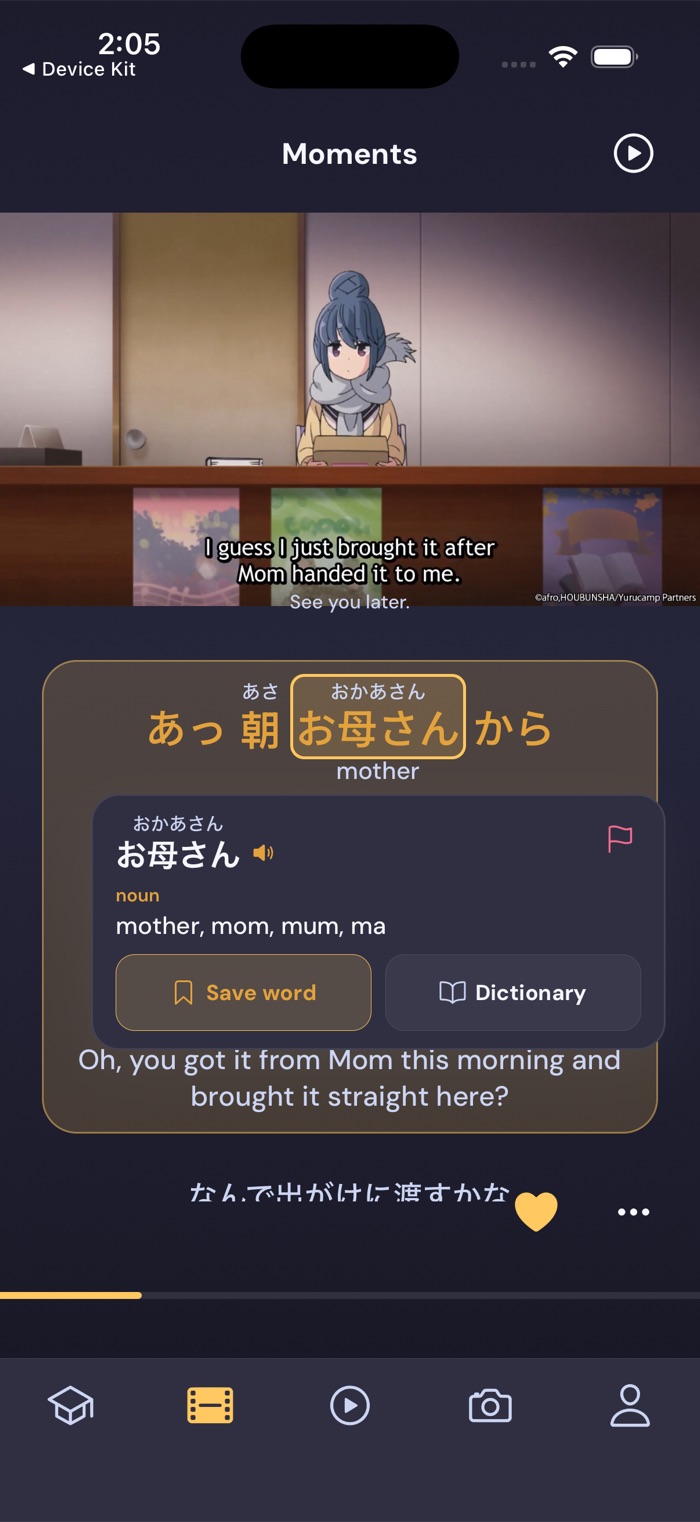
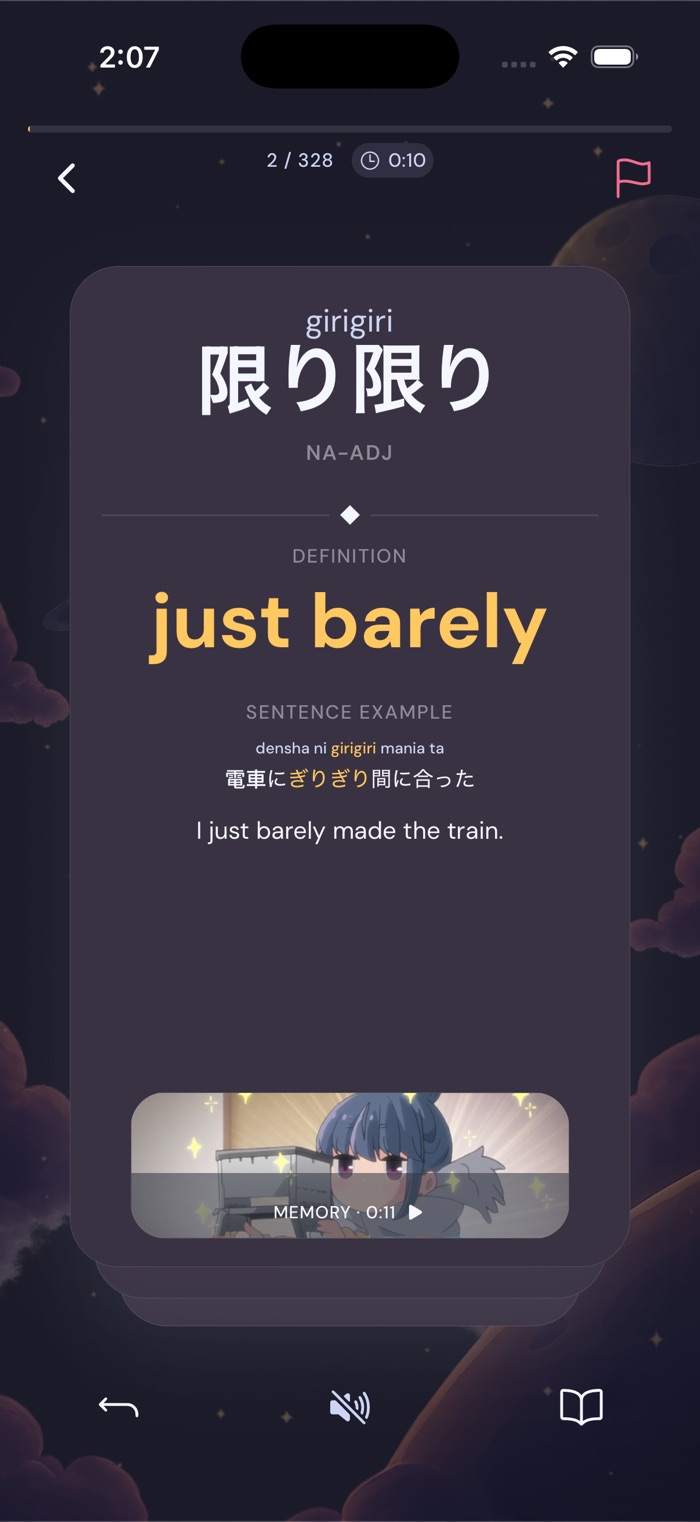
Moments teaches you words through doomscrolling; every flashcard keeps the moment it came from.
Whether you use it or not, the actual advice stays the same: pick something easy, start listening today, and accept that a lot of it will go over your head for a while. That’s how it’s supposed to work at the beginning.