
Duolingo has had a lot of backlash in the past year or so, and although some of it is fair, I think most of it is overdone. There is one thing it does better than any app I’ve ever tried, which is getting you to open a language app every single day, for months or sometimes years, most people would give up by the 3rd day. The most difficult part of language learning is developing a consistent habit, which they’ve done an incredible job at, and I’m not going to pretend otherwise.
The problem that I have with Duolingo is that showing up every day is not the same thing as acquiring a language, especially for one as complex as Japanese. The gap between doing your lesson every day and being able to understand a Japanese person talking is massive and takes a lot more work to become fluent than just a few short exercises and some satisfying noises.
Full disclosure before we go any further: we are a language learning app ourselves, so weigh everything in this post accordingly.
What Duolingo does well
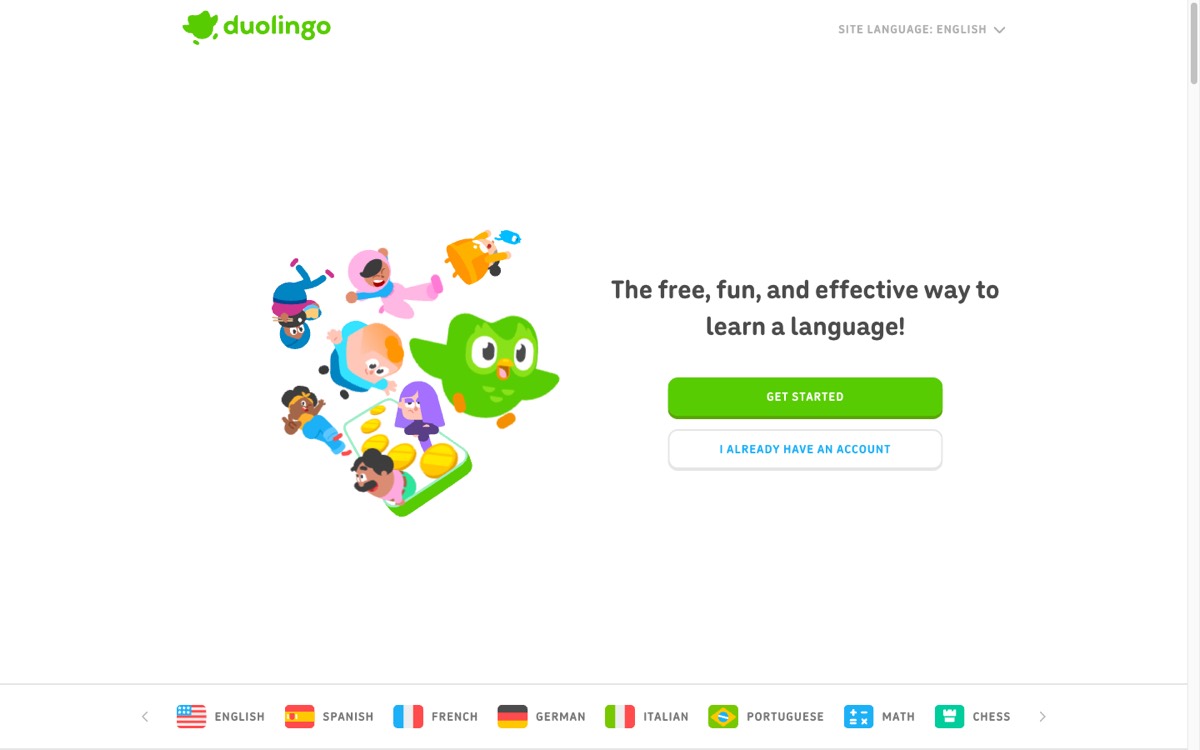 duolingo.com in July 2026.
The free tier is a bigger deal than people give it credit for. It has the same course content as its more expensive tier (albeit with ads), and most of the apps people recommend as Duolingo alternatives cost money.
It’s also very polished. Everything from the sound design, to the animations, to the lesson experience feels meticulously crafted, and it’s clear that there’s been over a decade of A/B testing behind every screen.
The streak system also keeps you coming back, and is a great way to act as a daily check-in to ensure you’re actually staying consistent. Duolingo managed to perfect that system, and apps have only been able to create shallow copies of it at best.
It’s also solid for kana and the absolute basics. Starting from zero, Duolingo will get hiragana and katakana into your head along with a starter set of greetings and survival phrases, and I have no complaints about that part. It makes for a reasonable first two months.
The chess lessons are also a nice plus I guess ;)
And now… the problems
Some of this applies to Duolingo in any language, but most of it bites harder in Japanese.
The kanji teaching is probably the weakest part. Duolingo mostly shows you kanji inside words and hopes exposure does the job, with no systematic approach to components, readings, or the difference between 生 in 学生 and 生 in 生ビール. Learners consistently report coming out of long Duolingo runs recognizing a handful of characters, but only in the exact word shapes the course drilled. Kelvin wrote about why half-learned characters can be worse than none in his kanji essay, and Duolingo’s approach produces pretty much exactly that half-learned state.
The sentences also have a machine-like quality to them. The Japanese course leans on sentences that are grammatically legal but that no human would actually say, in a stiff textbook register with odd word choices, and the community has been flagging quality-control issues in the course for years. Many people also believe the use of AI gen plays a big part in this (which I touch on just below).
Also what you end up practicing is matching English to Japanese tile puzzles rather than absorbing how Japanese actually sounds, and that matters more than it might seem, because listening comprehension is where Japanese hurts the most.
Then there’s everything that happened in 2025 and 2026. In April 2025 Duolingo announced it was going “AI-first,” and the backlash was bad enough that CEO Luis von Ahn later walked back the framing. Around the same time the hearts system was replaced with an energy system (25 energy, one per question), which power users hated so much that a visible chunk of them left, and by the February 2026 earnings call von Ahn was openly admitting that excessive friction had hurt user growth, with the company reportedly spending heavily to win users back. The stock also fell hard from its 2025 peak, though I’d take the specific numbers floating around Reddit with a grain of salt.
Companies sometimes make mistakes and Duolingo is clearly trying to fix these ones. I’m bringing it up because it probably explains why you’re reading this article at all: an unusual number of people are shopping for a Duolingo alternative right now, and a lot of them seem to be Japanese learners.
Why the course format becomes a downside over time
The argument I actually want to make isn’t that Duolingo is bad. It’s that Duolingo is, underneath the game mechanics–a course–and a course means a fixed syllabus: you progress through units someone else designed, in an order someone else chose, made of sentences someone else (or these days, something else) wrote. Every course has a ceiling and the Japanese one’s ceiling is low. After six months of honest daily use, a typical learner has maybe a few hundred words, shaky kanji, and close to zero comprehension of real Japanese speech, which is the part that tends to surprise people. Put on an actual Japanese podcast after a 180-day streak and you probably won’t be able to follow any of it, not because you’re bad at languages but because nothing in the course ever exposed you to Japanese at native speed, in native register, said by someone who isn’t a text-to-speech voice.
The thing that fixes that is input, meaning large amounts of real Japanese that you mostly understand: podcasts, streams, songs, YouTube, menus, manga. This isn’t a fringe theory, it’s about the closest thing acquisition research has to a consensus, and it’s the entire premise of the immersion communities that have been producing conspicuously fluent speakers since the AJATT days. The most natural-sounding non-native Japanese speakers you’ll find on YouTube almost all came out of that tradition rather than out of a course app. I wrote up the research side in our sentence mining post, and there’s a full beginner’s guide to learning Japanese through immersion if the whole idea is new to you.
Gravity is built for that side of things. It’s a curated library of real Japanese media (anime, music, podcasts, streams, all of YouTube) with word-synced transcripts, levelled N5 to N1 so you can find things you mostly understand. You follow along, tap any word you don’t know, and it becomes a flashcard with the original clip and sentence attached, and you can also point your camera at a menu or a manga page and mine vocabulary from that. The FSRS then prioritizes the words you keep running into, built upon the theory that a word you’ve seen four times across three shows deserves more of your review time than some random word you’ll never see again nor actually use.
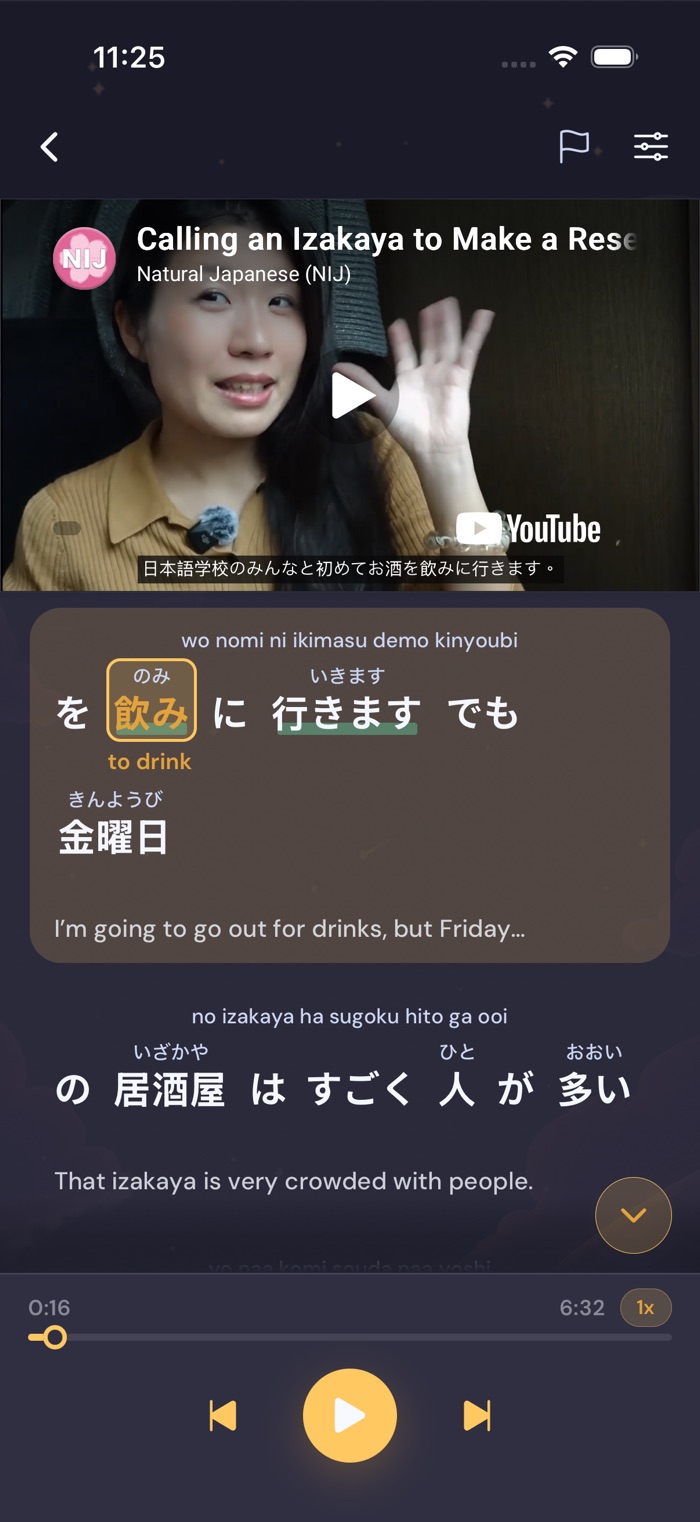
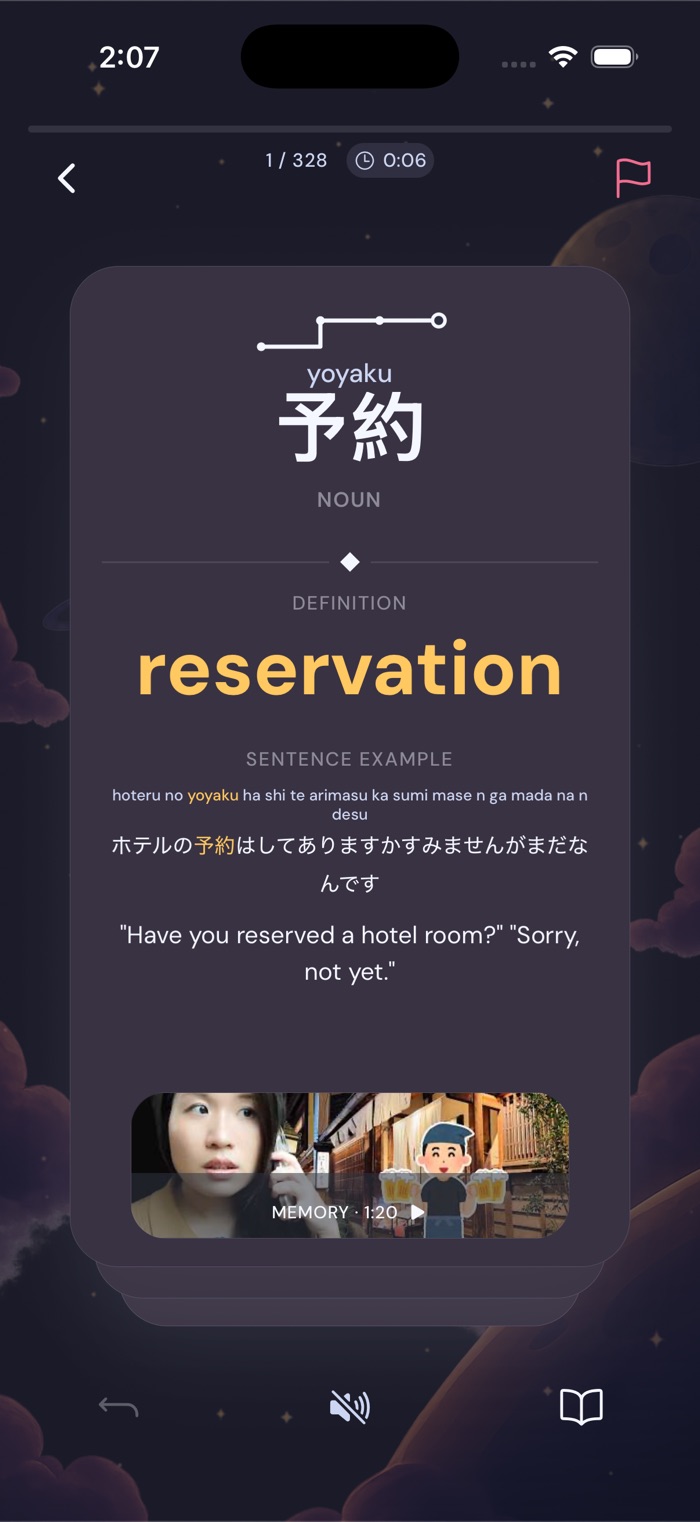
The transcript player follows the audio word by word; save a word and its flashcard keeps the clip it came from.
So what you’re practicing in each app is pretty different. A Duolingo session mostly trains you to assemble English translations from word tiles, while a Gravity session trains you to understand a real Japanese person talking at real speed, and if you shadow the lines out loud (the transcript makes this easy) it’s quietly training your speaking as well. Both count as practice, but the second kind carries over to actually being in Japan a lot more directly.
Here’s the comparison in table form.
| Duolingo | Gravity | |
|---|---|---|
| Price | Free with ads; Super ~$84/yr, Max ~$168/yr | $20.99/month or $98.99 a year, with 7-day free trial. Never ads. |
| What you practice | Translating tile-puzzle sentences from a fixed course | Understanding real podcasts, streams, and songs with word-synced transcripts |
| Kanji | Incidental exposure, no system | Met in real words, in context, tracked across encounters |
| Listening | TTS voices at drill speed | Native speakers at native speed, levelled N5–N1 |
| Grammar | Guided course, explanations improving (Explain My Answer free since Jan 2026) | Not covered; you’ll want a textbook or Tae Kim alongside |
| Habit machinery | Streaks, leagues, notifications; very hard to beat | Daily plans, but it won’t guilt you like the owl |
| Ceiling | A few hundred words, low real-speech comprehension | None built in: native content plus mining is the same path immersion learners have taken from beginner all the way to fluency |
When Duolingo is the better choice
There are real situations where Duolingo is the right call and Gravity is the wrong one, so I want to be honest about it.
The obvious one is price. Free beats paid, and Gravity comes from a three-person team without a big company subsidizing a free tier the way Duolingo’s is subsidized. If money is tight, Duolingo plus free community resources is a legitimate path and I wouldn’t argue with anyone taking it.
There’s also the habit engine, which I mentioned above but will repeat because quitting is the most common failure mode in this whole hobby. Duolingo’s streak psychology, leagues, and notifications are unmatched at keeping people from quitting. Gravity has daily plans, but if what you need is an app that guilts you into opening it every day, Duolingo does that better than we do.
Duolingo also asks nothing of you decision-wise. It tells you exactly what to do next, forever, whereas Gravity hands you a library and asks you to pick something, and for some people on some days even that small choice is more than they have energy for. Tapping matching tiles when your brain is fried at 11pm is a real use case, and I’ve done it myself.
Related to that, a Duolingo lesson fits into three spare minutes in a queue, while Gravity works best in 15 to 30 minute sittings where you can actually follow a piece of content. If your schedule genuinely only has three-minute gaps in it, that’s worth knowing going in.
And our own limitations, stated plainly: Gravity won’t teach you grammar from zero, so a true beginner needs Genki or Tae Kim’s guide alongside it, and it’s Japanese-only right now (more languages are planned, but they aren’t here yet). It also asks more of you than Duolingo does, since listening to real Japanese and mining it is more work than a lesson bubble, but honestly the effort is kind of the point, because putting in that work on real material is what makes it possible to ride the same app all the way to fluency instead of stopping where a course tree ends.
Using both
You don’t have to pick one, and honestly a combination is what I’d recommend to most people. Keep Duolingo as the thing that drags you into contact with Japanese every day, use it for kana and basic vocabulary, and put your real learning time into input, whether that’s Gravity or any other immersion setup (we compare more of them in our roundup of the best apps for learning Japanese). The input side is what builds the listening comprehension and vocabulary that Duolingo on its own never will.
If you’re more serious about it, swap the Duolingo slot for a real grammar resource: Genki I and II or Tae Kim for structure, plus Gravity for input and mining. That combination covers roughly what a $300-a-semester university course covers, plus the thousands of hours of listening the university course skips.
What I wouldn’t do is using Duolingo alone for Japanese past the six-month mark or so. By that point the streak is mostly telling you that you showed up–not that you’re improving–and there are better places to spend the next thousand days.
FAQ
Is Duolingo good for Japanese?
For kana, survival phrases, and building a daily habit, yes, genuinely. As your main tool past the first few months, I don’t think so. The kanji coverage is unsystematic, the sentences are stilted, and it gives you almost no exposure to Japanese at real speed, which is the skill Japanese punishes you hardest for not having.
How far can Duolingo take you in Japanese?
Finishing what most people finish (very few get through the whole course) leaves you with a few hundred words, patchy kanji, and beginner grammar. In practice that’s something like being able to read a menu with effort but not follow a conversation. It’s useful, but it’s nowhere near the N3-ish comprehension people imagine a multi-year streak buys them.
What’s better than Duolingo for Japanese?
It depends what’s missing for you. For grammar, Genki or Tae Kim. For kanji, WaniKani. For a friendlier Duolingo-style course with actual explanations, Airlearn is worth a look. And for the listening and vocabulary that come from real Japanese media, you want an immersion setup, which is the lane Gravity is in.
Summing up
Duolingo is very good at getting you to open the app every day, and the Japanese course itself is fairly mediocre, and both of those things are true at the same time. It deserves real credit for the first part. I’d just be careful about assuming a long streak means the Japanese is coming along with it.
Anyway, if you want to see what your listening comprehension does after a few months of real Japanese with a transcript under it, Gravity’s in early access on the App Store and Google Play. Bring a grammar guide and we’ll handle the input side.